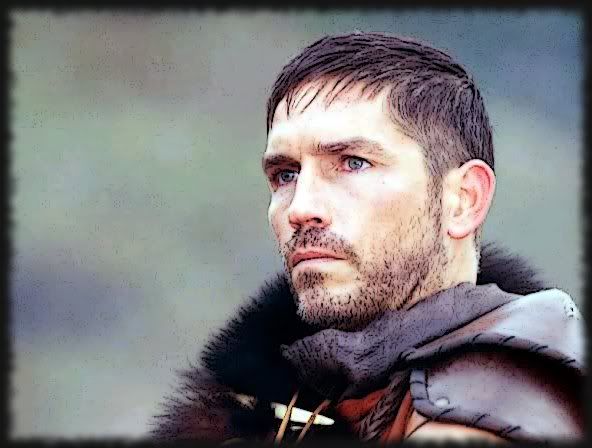
 April's Featured Character: Ulric Complex and dark, Ulric has been a favorite PC in Mizahar for a while. The Founders were generally surprised he had not received this award yet! The character's storyline has twists and turns and doesn't fail to surprise. If anyone has ever read a thread with Ulric, they know full well how talented his author is. So join me in congratulating him on being this month's featured character. 1. A little background, how did you find Mizahar and rp in general? Mizahar was, quite frankly, that striping dither of a shot flare through stormy, inclement gloom, ending not just a few hours, but years of rummaging. I’d wasted so many hours delving for a place to write, pulping my skull on so many cul-de-sacs of squandered imagination and banality. I didn’t want to play vampires. I didn’t want to play a haughty elf, and I wouldn’t compromise. I’m sure we’re all cognizant that roleplaying sites are mostly barren, just reliquaries of concepts that never got off the runway. It’s startlingly tricky to glean that sort of creativity in the first place, too. Accordingly, my first venture was on a general forum. I loosely grouped up with a few good writers over the span of the half year before I made my way here, yet despite the vagaries of our escapades, boredom and other concerns wormed their way into every story. I wasn’t able to finish anything, which left me jaded. I’ve always valued the permanence of long-term characterization, plots, and thematic material, and I wasn’t getting it there. So I left, and over the buoyant, fearing dusk of my collegiate days, I found an unrelenting universe populated by characters. I’ve never looked back. 2. Do you have any particular influences for your writing style? I’d assert that writers require inspiration, but the fusing and defining of style is an inherently elongated method. I used to write very deliberately, daubing my stories with starker imagery. It just didn’t evoke any magic, so I began thinking of how I could get better. Roger Zelazny was probably my first influence, for the eccentric, flowing stream of consciousness over the Great Book of Amber left me rife with jealousy. I wanted to do that, so I began trying to meld elements of dreams/trances with reality. Steven Erikson assisted me in ditching my word-chaff in favor of crude, yet jumbled brevity, as did Anton Chekhov and Haruki Murakami. I’m now of the persuasion that phrases, if absent reason, just choke the points you’re actually trying to make. R. Scott Bakker spurred me to bridge the abyss that yawns between frivolity and profundity, even if I don’t always succeed. Right now, my prominent influences are Mervyn Peake, who gave us Titus Groan and Titus Alone, and the poet, Alan Ginsberg. Peake’s prose fascinates me, because it’s erratic, jumbled in so many ways, yet conjures up such brilliant imagery and depths of attachment. But I don’t hold any illusions. Though the narrative is ponderous, defying convention, it just touches me in a way. Ginsberg, however, has me wondering if I’m more attracted to poetry. I can’t write simply. It’s not me, though I make use of certain elements of necessity. I’m just lyrical, and reading through his (often colorful) poetry influences my uses of figurative language to illustrate my themes. 3. Where did your concept of Ulric come from? Ulric’s concept is very old, derived during the course of juvenile machinations and subsequently drowned by sloth. I’d intended him as a symbol of masculine duality, though reflected with scant sympathy. He’s a cold, hard man, nurtured by a cold, hard world and preyed on by powers beyond his control. He’s meant to be very primal, yet at the same time, very intelligent, very defiant. His psyche, back in those early days, was invariably defined not by his crimes, but an underlying crusade for redemption. Also, I’ve got to pay homage to Tennessee Williams’ Cat on a Hot Tin Roof. Brick is partly an inspiration for Ulric. If there’s one, profound turn of phrase that’s influenced my concept, it’s: “Mendacity is a system we live in. Liquor is one way out, an’ death’s the other.” Ulric’s defiantly tangled by that system, and he’s trying so hard to find something real, and truthful to hang on to so he doesn’t drown under the deluge. 4. Do you have a method as to how you approach writing a post for your character? Not really. I’m barely versed in the technical aspects of writing, and the use of literary devices just mystifies me and ties my head in knots. I just used to read so frequently, I kind of shape everything based on feel. I only think, what am I trying to say? In the end, my object is to pry at obscured, underlying themes, to maybe consider the inlay of philosophy. I can’t write banality. 5. Has your original idea of his character changed since you began? Invariably. I did, after all, swiftly retool his history to comply a few rudiments of lore, and subsequently elaborate on certain relationships during the course of play. I left my trumps in the bag, though. I began with the firm shell of his persona. I’ve got an intrinsic conception of his desires, his demeanor, his responses to a medley of stimuli. He mostly writes himself, which often leads me to ask, why did he just do that? I’d say that my comprehension of him is partly retrospective. Ulric has delved through many, vicious stages in his life, but I’d say that his changes are inherent to a deeper maturation. I’ve also tried to make every event in his life affect him on a deeper level. In particular, that includes the quilting of segments of his history through flashbacks to explain why he is what he is. In the Bone Hunter, for which I’ve yet to write Acts III and IV, you see him inquiring, brooding, cursing the whims of fate, and largely becoming. I find them a pleasure to write, for the younger man isn’t quite so brutal, as ruthless as he later becomes, as if he’s on the brink of salvation. Glav Navik, the unchaining of Ivak, Krysus, and Xhyvas prompted me to deviate most decidedly from the master plan, though. Krysus put a tracker on Ulric after his gruesome flayings, which I didn’t really ask for. He may be the most violent of men, but he’s ironclad in his conviction that choice is sacred. He’s not that sort of killer, and his rejection of her was very harsh during their eventual standoff, defining him for nearly a year. I’m not going to lie, it was a difficult, trying period as a writer, because I’d been forced to deviate entirely from his concept. Ulric didn’t find the redemption that’d been slated as his driving purpose, mostly because he’s not destined to find that radiance at the end of the tunnel. He just had other tasks. Xhyvas, for one. I don’t know about you, but when Gossamer offers to develop a plot for you, you take it and don’t look back. It’s going to irrevocably change your character, but sometimes that’s a great thing. I decided that I’d play it to the hilt. Xhyvas was a dead god at the time, and Ulric holds a potent affinity for the hopeless, the powerful belief in transcending over the cages of body, mind, and circumstance. Xhyvas’ murder was an injustice he just couldn’t tolerate, and he devoted himself utterly to ensuring that resurrection. That’s the kind of somber duty, chained by a zeal and devotion that I’d never have expected of him from the opening of his story. He used to be a self-preserving pragmatist, not a self-sacrificing, partly deluded acolyte. 6. I won’t say Ulric’s “crazy”, but he’s certainly not a picture of peace and sanity. What are the challenges in portraying that as a writer? Actually, he was. At first, the singular most critical artifact of his history was in beholding, and forgetting, the flaying of his father. And it was just an avalanche from there. That’s what arose when I finally began writing that fateful scene of his murder. There’s a faint, tremulous music in his ears, an infernal rapture that drives him to carve his betrothed and her lover into slivers of glistening, wetly flapping flesh. It’s perverse, not least because in the midst of that emotional trauma, he’s recreating his father’s murder and getting off on the power. That just evoked a niggling discontent, and desire to expand upon his awfully generic sort of depraved berserker madness. Though I’d already committed to multiple personalities, I decided on giving one of them a sort of agency. That led to the budding of his Homicidal Child Maniac, which was basically a carbon copy of himself as a child, eternally trapped by the events transpiring in that bloody cellar for the better part of their life. HCM, as I fondly grew to know him, awakened during those murders, and was subsequently released from his prison when Ulric, displaying his defiance at Krysus’ attempt at seducing him to her cause, resisted until his head literally broke in a flood of repressed memory. HCM stayed low, gradually taking control of the body until he eventually succeeded. He wasn’t exactly evil, after all. He was just a scared, lonely, grieving child caught in a man’s body, driven by a nebulous desire for revenge. HCM’s confused interactions with Wind Reach and its people were a pleasure to write, but eventually, Ulric refused to accept his usurpation any longer. And in dramatic fashion, they fought over control of the mind and body, culminating in Ulric holding the HCM in sympathy and forgiveness, accepting the entirety of his agony, his wrath, and ultimately dispelling its existence. Ulric isn’t crazy now, though. I’d venture that he’d incredibly composed, just a fanatic in exposing the flaws of a world swiftly descending to chaos. If he’d speak plainly, he’d say, “I’d rather you discarded your pride, your prejudices, and your paltry deceits, so you can be rescued from the emptiness of a fate already written for you.” Xhyvas’ creed, to him, means liberating entire races from their deficiencies, and though his methods vary, he’s valiantly focused on ensuring that. 7. Ulric has had quite a few life-changing experiences. Can you pick one that impacted his makeup most? If so, what made it especially powerful? Xhyvas. The answer is Xhyvas. But since I’ve already talked about him, I’m going to say it’s Naama. Ulric was devoted to Xhyvas so utterly, so purely that even though part of him rebelled at the concept of losing himself, he wouldn’t swerve from that course. He’d come to believe, after being charged with the task of restoring Xhyvas, that as incarnate, he’d have to become Xhyvas. Xhyvas took over his dreams, where he just stalked around the wrecked memory of that temple as the usurper Ur-Xhyvas, raging at his impotency, the despondent inevitability of his failure. There’s no crueler, twisting fate, I’d imagine, than the compulsion to become a god, already discerning that you’ll have to sacrifice everything of yourself. Ulric’s fervor was internally rupturing, until that night he was drinking propped against a teasingly phallic object of statuary. Naama filled that void in his life. Xhyvas was his entire purpose for living, but her affections left him shackled by doubt. Ulric has always desired to be a regular person, so he’s always grappling with losing those last remnants of himself. He’d sunk so far into his duty, he was breaking under the crush of that barren yoke. Naama hasn’t been entirely faithful, either. That prefaced their embarkation upon a largely understated sequence of events, which convey his maturation finer than anything else does, I think. Keep in mind, Ulric flayed the last woman that betrayed him, and he swiftly, intermittently executes people for disregarding his counsel. But with her, he conquers that savagery. His affection for her is simply more powerful, and he rejects the sacrifice he intends to restore his dead god, binding his soul to hers with oaths of undying love. He’s deeply infatuated, and now they’re joined by Cheva, he’s dispending of many injuries that’ve plagued him for perpetuity. 8. What’s something you feel is missing from Ulric’s story? Ynara Dagor-Fyr, that’s who’s missing. Ulric’s darling, devious mother is a figure I’ve kept under wraps for a while. I’m gearing up to yank her from the shadows, and let her take center stage for a while. I’d begun trying to dredge at the dynamic of fathers and sons, but when I tried defining his mother, I got a bit carried away. I asked myself, what if his entire life is a lie? From there, it got twisted in a hurry. There were so many layers, each with their unique caveats, which just got me frustrated. It’s bad to jumble up your plotlines, particularly when you’re trying to reincarnate into a god, so I placed it on the back burner. I’m only now conjuring it from there, and the conspiracy I’m laying out gives me shivers. 9. What typifies Ulric’s relationships with other people? Ulric doesn’t just talk, he’s constantly stringing purpose. He just wants them to understand, for he’s always chasing the entirety of existence, rejecting the mundane. He doesn’t have many dealings, consequently. He insults, insinuates, intimidates. I’d have to say, he’s probably the most unflinchingly unpleasant character to encounter. Not only is he bent on manipulation, but he relentlessly attempts to subjugate, just to see if he’ll be defied. If you haven’t noticed, he’s also an enduring racist. I don’t find that inherently troubling. It’s typical to distrust, and likely despise what’s alien to you, so he’s always affected by that. I’d have to admit, it’s easy to mistake him for a barbarian. It’s just a difference of perception. I get grumpy anyway, though. He’s not just a brute, but a flare of veracity in a world debased by deceit. He’s heavily influenced by his upbringing. Ravok’s a city of art and culture, but there’s also a darker beauty, the implacable myriad of duplicity limning every face, every honeyed furl of the tongue. There’s just an absence of trust. That’s why he’s always forcing people away, or gazing deeply in their eyes, desperately seeking to comprehend what he glimpses there. 10. Can you describe a good foil or counterpart for Ulric? Ah, yes. I certainly can. I’d have to say, I enjoy characters that’re nebulous, kind of scattered in their conceptions of reality. I’d require an offset to his sheer level of intensity, to tweak his mercurial temper so he’s not as focused on dim, gloomy thoughts of redemption. If you’ve read any of his threads for the last two, maybe three seasons, you’ll notice that crows are everywhere. It’s very deliberate on my part. I’ve always been fascinated by those ragged, mocking crows. I’d never argue they’re proud, or even dignified, but they’re inherently truthful in every instant. That said, I’ve always fancied a Crow Kelvic. The kind that’d confront his delusions, remind him of his inadequacy. Ulric is just a man, but the further he delves into the flesh pits of reason, he’s becoming more of a symbol, less relatable when he speaks in his riddles. In a way, he’s turning away from his concept in that aspect, too. I’d like him to be around somebody who’s brazen, unflinching, and sarcastic, who’ll offer him a different sort of perspective. Also, somebody he’s not madly enraptured by, so he can actually show a sliver of backbone. Naama tamed him, so now he’s like her boytoy. 11. What is your favorite part about writing for this character? Ulric’s a guilty pleasure, from plumping the depths of philosophy to pulping faces. He usually writes himself, freeing me to make him into a vessel for a medley of concepts, themes, and questions. He’s kind of a prophet, in that false, grumpy way of his, which focuses him so entirely on deluges of thoughts that, when faced by incongruity, he’s forced to reconsider everything. For me, he’s kind of an enigma. Like he’s not really a man, but some vast, inexorable figurehead, imbued with its own, somber gravity. That’s what appeals to me the most. He’s a warrior-poet, unrepentantly tangled by a vaguely sordid nihilism, but also a prescient desire to redeem humanity of weakness, whether through peace and harmony, or the crucible of genocide. He doesn’t daub everything with the concerns of flesh and blood, but with implacable, cosmic truths, rendering his interactions with others extremely unpredictable. 12. Any advice for newer players? Well, there’s no denying the intimidation factor of having to grasp the extensive lore, deal with established players, and acquire permission for many character concepts. I’d have to say, the most important piece of advice I can give you is don’t be afraid to ask. I’m not counseling you to ask as many questions as you can, though. If you’re searching for specific kernels of knowledge, you’re sure to glean others during the way. It’s that autonomy that frees storytellers to dapple their domains with quests, and other development. I’d also say that you’ve got to fall in love with the lore, instead of squeezing in with a defined concept and doggedly trying to make it fit. It’s necessary to stay elastic, and if you can, mull over the intricacies so you’re not starting out bare-bones. It sets you apart from the pack, and we do take notice of that, leading to chances to collaborate with many writers, selection for quests, and to rise higher than you’d ever imagined. 13. What do you see in Ulric’s future? Ulric’s presently in Ravok, where he’s trying to kill his mother, Ynara, rescue Naama’s sister, Niobe, and basically, burn the city until it sinks in the lake’s jet-mirror bowels. None of that’s probably going to happen, though. Right now, I’m trying to scour away his selfish desire for fruition, and in doing so, recast him as a noble, capable leader of men. It’s not really working. Honestly, he’s so irrevocably devoted to Xhyvas, having already carried the god’s essence in his body, founding a temple, and trying to find converts, that I badly want him to be marked as Xhyvas’ Champion. If not that, than at least a priest, for that’s basically what he’s doing, anyway. It’s difficult just playing a usurper, particularly when he’s flushed with so much zeal for his god. I’d say that’s one of a pair of wants. I’m also infatuated with castles, so the other’s naturally to raise one of those behemoths, and find a few, intrepid souls to carve out a kingdom in the mountain crags. |
- Getting Started
- Help
- Master Lists
- Useful Links
- Features
Ulric is April's Featured Character!
(This is a thread from Mizahar's fantasy roleplay forums. Why don't you register today? This message is not shown when you are logged in. Come roleplay with us, it's fun!)
25 posts • Page 1 of 3 • 1, 2, 3

-

Shai - Alone in the dark.
- Posts: 487
- Words: 424135
- Joined roleplay: October 9th, 2011, 5:43 pm
- Location: Sunberth
- Race: Symenestra
- Character sheet
- Storyteller secrets
- Scrapbook
- Plotnotes
- Medals: 2
-


Ulric is April's Featured Character!
 by Eridanus on April 1st, 2012, 6:49 am
NOTICE: I am currently mostly inactive til August. As such, guild activities are temporarily halted (watch out for major revamps, changes and organizations when I'm back in full force). Any activity with Eri will be rather slow as well, but I am slowly readjusting back to "Mizahar life", so to speak, so do PM me if we have a thread that I left hanging and we'll talk.
"You must be one hardcore scholar, Eri." (Laszlo)
First winner of the prestigious Mirage's No Kill Medal.
Order of Transcendence
Mizahar's one and only player-run Mage Guild
(WIP) HQ | Recruitment | Network Registry
Mizahar's one and only player-run Mage Guild
(WIP) HQ | Recruitment | Network Registry
"You must be one hardcore scholar, Eri." (Laszlo)
First winner of the prestigious Mirage's No Kill Medal.
-
Eridanus - It's Peanut Butter Jelly Time!
- Posts: 1893
- Words: 1312082
- Joined roleplay: October 24th, 2011, 2:03 am
- Location: Sylira
- Race: Ethaefal
- Character sheet
- Storyteller secrets
- Scrapbook
- Plotnotes
- Medals: 8
-

-


-


-

Ulric is April's Featured Character!
by Ana Sol Starris on April 1st, 2012, 7:06 am

-
Ana Sol Starris - Sneak Thief
- Posts: 719
- Words: 706912
- Joined roleplay: January 11th, 2012, 3:27 am
- Location: Syliras
- Race: Human
- Character sheet
- Storyteller secrets
- Journal
- Plotnotes
- Medals: 2
-

Ulric is April's Featured Character!
by Naama on April 1st, 2012, 7:11 am

-

Naama - Chunki Faguta
- Posts: 395
- Words: 130159
- Joined roleplay: February 13th, 2011, 2:53 am
- Race: Mixed blood
- Character sheet
- Storyteller secrets
- Scrapbook
- Plotnotes
- Medals: 3
-


-

Ulric is April's Featured Character!
by Laszlo on April 1st, 2012, 8:43 am

In the daytime I am one of Syna's fallen.
At night, I am Symenestra.
At night, I am Symenestra.
-
Laszlo - Team Imass!
- Posts: 846
- Words: 635811
- Joined roleplay: September 3rd, 2011, 3:36 am
- Location: Lhavit
- Race: Ethaefal
- Character sheet
- Storyteller secrets
- Scrapbook
- Medals: 5
-
-
-
Ulric is April's Featured Character!
by Seven Xu on April 1st, 2012, 1:14 pm
- Seven Xu
- Rhetoric can't raise the dead.
- Posts: 976
- Words: 567538
- Joined roleplay: April 30th, 2011, 11:02 pm
- Location: Alvadas
- Race: Mixed blood
- Character sheet
- Storyteller secrets
- Scrapbook
- Plotnotes
- Medals: 2
-
Ulric is April's Featured Character!
by Victor Lark on April 1st, 2012, 3:10 pm
- Victor Lark
- How does that make you feel?
- Posts: 612
- Words: 412831
- Joined roleplay: April 8th, 2011, 8:33 pm
- Location: Alvadas
- Race: Human
- Character sheet
- Storyteller secrets
- Scrapbook
- Plotnotes
- Medals: 1
-

-

Kamalia Timandre - I send a hail of burning ice!
- Posts: 490
- Words: 254985
- Joined roleplay: September 8th, 2009, 8:37 am
- Location: Alvadas, City of Illusion
- Blog: View Blog (1)
- Race: Konti
- Character sheet
- Storyteller secrets
- Scrapbook
- Plotnotes
- Medals: 7
-

-


25 posts • Page 1 of 3 • 1, 2, 3
Who is online
Users browsing this forum: No registered users and 0 guests